
Manufacturing Profit Margin Calculator
Calculate Your Profit Margins
Enter your financial data to see your gross, operating, and net profit margins compared to industry benchmarks
Enter Financial Data
Industry Benchmarks
| Sector | Gross Margin | Operating Margin | Net Margin |
|---|---|---|---|
| Food Processing | 20–30% | 10–15% | 5–10% |
| Pharmaceuticals | 40–60% | 25–35% | 15–25% |
| Automobile Parts | 15–25% | 8–12% | 3–7% |
| Electronics Assembly | 18–28% | 9–14% | 4–9% |
| Metal Fabrication | 22–32% | 12–18% | 6–11% |
Results
When you’re planning a manufacturing startup, the first number you’ll obsess over is the profit margin. It tells you whether the business can survive the raw‑material costs, labour bills and all the hidden expenses that pile up on the shop floor.
In this guide we break down exactly what profit margin means in the context of the Manufacturing industry the sector that transforms raw inputs into finished goods, show you step‑by‑step how to calculate it, compare typical margins across sub‑sectors, and give you practical ways to push that number higher.
What is profit margin?
Profit margin is the ratio of profit to revenue, expressed as a percentage. In plain English, it answers the question: for every £1 of sales, how many pence stay in the business after covering costs?
Types of profit margin you’ll hear about
- Gross profit margin - (Revenue - Cost of Goods Sold) ÷ Revenue. It focuses on the cost of materials and direct labour.
- Operating profit margin - (Gross profit - Operating expenses) ÷ Revenue. This adds overhead, utilities and depreciation into the mix.
- Net profit margin - (Net profit ÷ Revenue) × 100. The bottom‑line figure after taxes, interest and any extraordinary items.
How to calculate profit margin in manufacturing
- Gather total sales revenue for the period you’re analysing (usually a fiscal year).
- Determine your Cost of Goods Sold (COGS). This includes raw material purchase price, direct labour, and manufacturing overhead allocated to each unit.
- Choose the margin type you need:
- For gross margin, use Revenue and COGS only.
- For operating margin, subtract all operating expenses (rent, utilities, salaries of non‑production staff, marketing, R&D, etc.) from gross profit.
- For net margin, subtract interest, taxes and any one‑off costs from operating profit.
- Apply the formula: (Profit ÷ Revenue) × 100. The result is your percentage margin.
- Round to one decimal place for easy comparison.
Example: A small metal‑fabrication firm reports £2.5 million in sales. COGS is £1.6 million, operating expenses total £500,000, and tax plus interest amount to £70,000.
- Gross profit = £2.5 m - £1.6 m = £0.9 m → Gross margin = (0.9 / 2.5) × 100 = 36.0%
- Operating profit = £0.9 m - £0.5 m = £0.4 m → Operating margin = (0.4 / 2.5) × 100 = 16.0%
- Net profit = £0.4 m - £0.07 m = £0.33 m → Net margin = (0.33 / 2.5) × 100 = 13.2%
Key cost components that squeeze profit margins
Understanding where money disappears helps you protect or improve margins. The main culprits in most factories are:
- Cost of Goods Sold (COGS) - raw material price volatility, especially for commodities like steel or plastics.
- Manufacturing overhead - utilities, equipment depreciation, and factory lease.
- Direct labour - wages, overtime premiums, and training costs.
- Supply chain inefficiencies - excess inventory, long lead times, and freight surcharges.
- Quality rework - scrap, re‑inspection and warranty claims that add hidden expense.
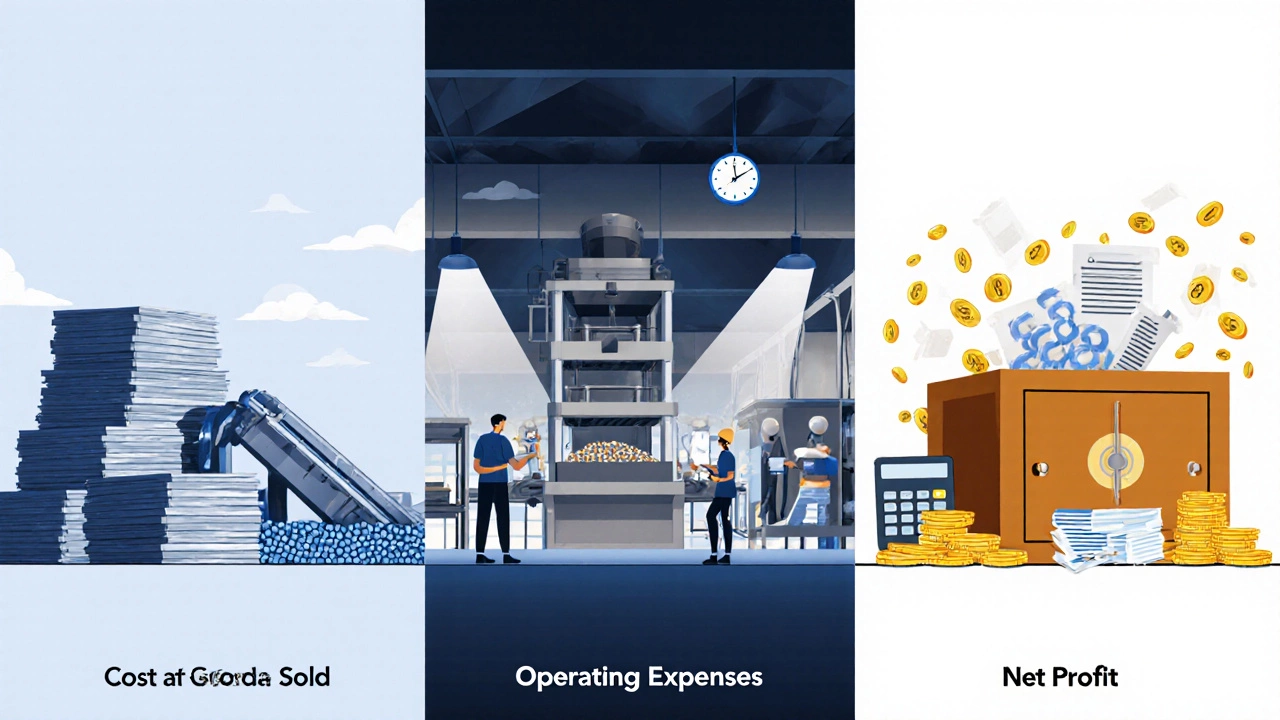
Industry benchmarks - how does your margin compare?
| Sector | Gross Margin | Operating Margin | Net Margin |
|---|---|---|---|
| Food Processing | 20-30% | 10-15% | 5-10% |
| Textile Manufacturing | 25-35% | 12-18% | 6-12% |
| Pharmaceuticals | 40-60% | 25-35% | 15-25% |
| Automobile Parts | 15-25% | 8-12% | 3-7% |
| Electronics Assembly | 18-28% | 9-14% | 4-9% |
| Metal Fabrication | 22-32% | 12-18% | 6-11% |
These figures come from the UK Manufacturing Cost Survey 2024 and give a realistic baseline for new ventures. If your numbers sit well below the operating margin range, it’s a red flag that something in the cost structure is off.
Strategies to improve profit margin
Boosting profitability isn’t about cutting corners; it’s about smarter allocation of resources.
- Lean manufacturing - eliminate waste, streamline workflows, and adopt just‑in‑time inventory to cut holding costs.
- Automation - invest in CNC machines or robotic cells where labor costs exceed the equipment payback period (usually 2‑3 years in high‑volume runs).
- Supplier negotiation - lock in multi‑year contracts for key commodities, or diversify sources to avoid price spikes.
- Value‑based pricing - focus on the unique benefits your product offers and price accordingly, rather than competing solely on cost.
- Energy efficiency - retrofit lighting, install variable‑speed drives, and monitor consumption with IoT sensors; savings of 5‑10% are common.
- Product mix optimisation - prioritize high‑margin SKUs and phase out low‑margin items that tie up capacity.
Common pitfalls to avoid
- Ignoring indirect costs such as equipment downtime and quality inspections.
- Relying on a single large customer - any contract loss instantly shreds the margin.
- Overestimating sales volume and then over‑investing in capacity.
- Failing to update the margin calculation regularly; costs change every quarter.

Profit margin vs. other profitability metrics
While margin percentages are great for quick health checks, they don’t tell the whole story.
- Return on Investment (ROI) measures the efficiency of capital spending, useful when you’re evaluating new machinery.
- Break‑even point shows the sales volume needed to cover all fixed and variable costs - a critical figure before you set a price.
- Cash conversion cycle tracks how fast you turn inventory into cash, affecting working‑capital and ultimately the margin you can sustain.
Use these metrics alongside margin analysis to get a 360° view of your manufacturing business.
Quick checklist for a healthy profit margin
- Calculate gross, operating, and net margins each month.
- Compare to industry benchmarks specific to your sector.
- Identify top three cost drivers and set reduction targets.
- Review pricing strategy quarterly - ensure it reflects value and cost changes.
- Implement at least one lean or automation improvement every 6 months.
Frequently Asked Questions
What is the difference between gross and net profit margin?
Gross margin only subtracts the cost of goods sold from revenue, showing how efficiently you turn raw inputs into finished goods. Net margin subtracts every expense - operating costs, taxes, interest and one‑off items - giving the final profitability after all deductions.
How often should I recalculate my profit margins?
At a minimum, run the numbers at the end of each fiscal quarter. High‑growth startups often calculate them monthly to catch cost spikes early.
Can I improve margins without raising prices?
Yes. Lean practices, better supplier terms, energy‑saving upgrades and automation can all cut costs enough to lift margins while keeping prices stable.
What is a ‘good’ profit margin for a new manufacturing startup?
A realistic target is an operating margin of 8‑12% in the first two years. This aligns with the averages for metal‑fabrication and electronics assembly sectors.
How do I account for inventory write‑downs in margin calculations?
Treat the write‑down as an additional COGS line item. It reduces gross profit, which then cascades down to operating and net margins.