Production Type Calculator
1. Do your customers expect customization?
Personal names, unique designs, special sizes
2. How quickly can you produce an item?
Can you make each item in under an hour?
3. How many items can you produce daily?
Can you make 10 or more identical items in a day?
4. Do you have storage space?
For raw materials and finished goods between batches
5. What does your customer value most?
Personal connection or consistent quality?
Recommended Production Type: Job Production
Your business is best suited for job production. This means making one item at a time, tailored exactly to customer requests. You'll thrive with custom orders where uniqueness and personal connection matter. Focus on high-margin, customized products that customers are willing to pay more for. Note: This requires skilled workers and careful time management.
Common Uses: Custom furniture, bespoke clothing, artisanal products
When you think of small scale production, you might picture a local bakery making sourdough loaves every morning, or a craftsman hand-stitching leather bags in a garage workshop. These aren’t just hobbies-they’re real businesses that rely on two main types of small scale production: job production and batch production. Neither is better than the other. They just serve different needs. And understanding which one fits your operation can make the difference between barely breaking even and building a sustainable local business.
Job Production: One at a Time, Made to Order
Job production means making one item at a time, tailored exactly to a customer’s request. There’s no assembly line. No repeating the same thing over and over. Each piece is unique. Think custom furniture built to fit a weirdly shaped room, a tailor-made wedding dress, or a hand-forged knife engraved with a family crest. This is the purest form of small scale manufacturing.
It’s slow. It’s labor-intensive. And it demands high skill. But it also lets you charge more. A bespoke wooden dining table made from reclaimed oak can sell for £1,200, while a mass-produced one from a warehouse might cost £300. The difference isn’t just in materials-it’s in the story, the personal touch, the fact that no one else has the same thing.
Businesses using job production rarely keep inventory. They don’t make things until someone pays for them. That cuts down on waste and storage costs, which is a huge advantage for small operators with limited space. But it also means you can’t scale quickly. If five customers want custom tables next week, you can’t just crank them out. You’ll need to manage their expectations on delivery times.
Job production thrives where uniqueness matters: artisanal goods, repair services, prototype development, and niche technical work. In Liverpool, you’ll find job producers making custom marine fittings for fishing boats, restoring vintage radios, or building musical instruments for indie bands. These aren’t factories. They’re studios. And they survive because customers are willing to wait-and pay-for something made just for them.
Batch Production: Making Groups of the Same Thing
Batch production is where you make a set number of identical items in one go, then switch to something else. You might produce 50 jars of handmade jam, then clean your equipment and make 30 batches of lavender soap. After that, you switch to 100 ceramic mugs. Each group, or ‘batch’, is produced together before moving on to the next product.
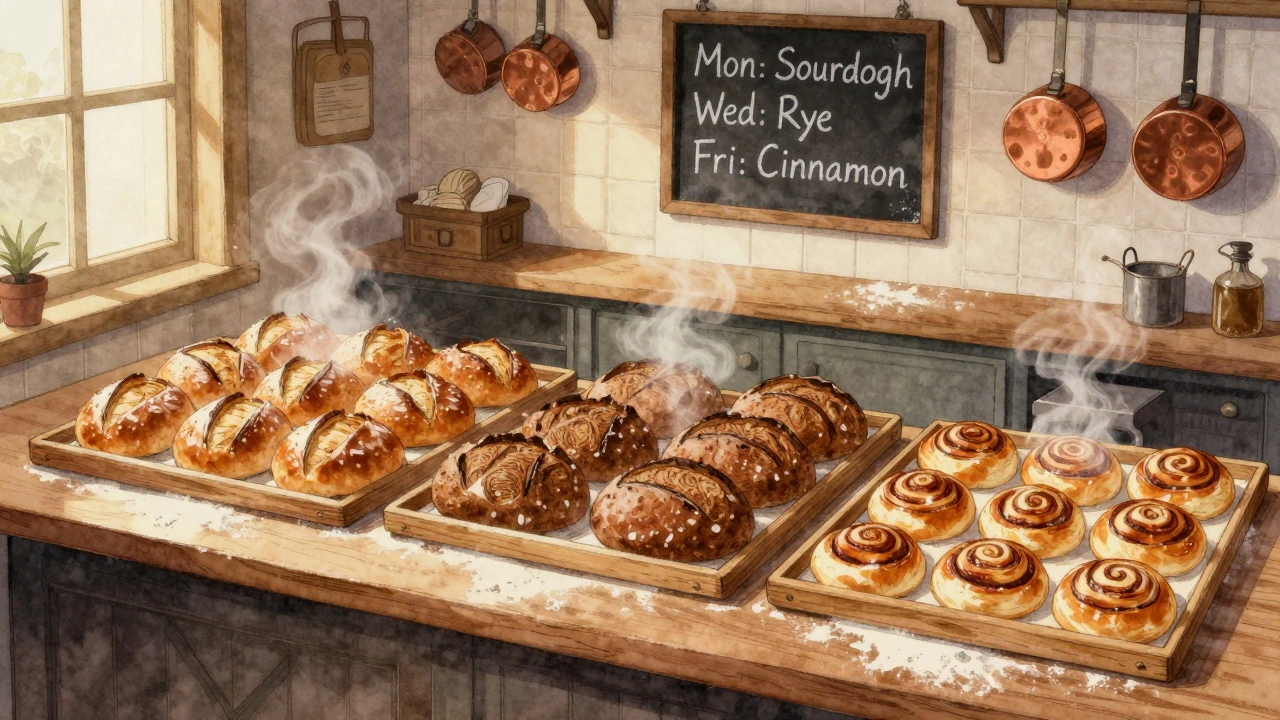
This method strikes a balance between the flexibility of job production and the efficiency of mass production. It’s common in small food businesses, craft breweries, and local textile makers. A bakery in Bootle might bake 120 sourdough loaves on Monday, 80 rye breads on Wednesday, and 200 cinnamon buns on Friday. Each batch uses the same oven, same tools, same staff-but the product changes.
Batch production lets you spread out fixed costs. You don’t need a separate oven for every product. You can train staff to handle multiple tasks. And you can respond to seasonal demand-more mince pies in December, more iced cakes in summer. It also gives you better control over quality. You inspect the whole batch before it leaves the workshop. If one loaf burns, you know it happened in batch #3, not batch #12.
The downside? You need space to store raw materials and finished goods between batches. And you can’t react instantly to sudden spikes in demand. If 50 people suddenly want your sourdough next Tuesday, you can’t just make 50 more right away-you’ve got to wait until your next scheduled batch day.
How to Choose Between Job and Batch Production
So how do you decide which type fits your business? Start with your product and your customers.
- If your customers want customization-personal names, unique designs, special sizes-go with job production.
- If your customers want consistency-same taste, same look, same packaging-batch production is your friend.
Also think about your resources. Job production needs skilled workers who can handle varied tasks. Batch production needs good scheduling and storage. You don’t need fancy machinery for either, but you do need discipline.
Many small manufacturers mix both. A leatherworker might make custom belts (job) on weekdays, then run a batch of 30 identical wallets on Saturdays. A pottery studio might create one-of-a-kind vases (job) for gallery shows, then produce 50 matching tea sets (batch) for local gift shops.
The key is knowing what you’re optimizing for: uniqueness or volume. You can’t maximize both at once. Pick your focus.
Real Examples from Small UK Businesses
In Manchester, a small workshop called Steel & Stitch makes custom bike frames using job production. Each frame is designed around the rider’s height, riding style, and preferred materials. They’ve built 147 frames in three years-none the same. Their customers pay £1,800 each. They don’t advertise online. They rely on word of mouth and local cycling clubs.
Down in Stoke-on-Trent, Clay & Co. uses batch production to make hand-thrown ceramic mugs. They fire 200 mugs per batch, glaze them in three colors, and sell them to 12 local cafés. They don’t take custom orders. Their profit comes from volume and repeat business. Each mug sells for £12. They’ve scaled to 15,000 mugs a year without hiring more staff.
Both are successful. One is built on personal connection. The other on reliable supply. Neither uses robots. Neither needs a warehouse. Both rely on human skill and smart planning.

Why This Matters for Small Business Owners
If you’re starting a small manufacturing business, choosing the wrong production type can sink you before you even break even. Too many people try to do batch production when they should be doing job production-and end up stuck with unsold inventory. Others try to make everything custom and burn out trying to keep up with demand.
Ask yourself these questions:
- Do customers expect to customize their order? → Job production
- Do customers want the same product as someone else bought last week? → Batch production
- Can I make this in under an hour? → Job production
- Can I make 10 of these in a day? → Batch production
- Do I have storage space for raw materials and finished goods? → Batch production needs it
- Do I have time to explain each item’s story to the buyer? → Job production thrives on this
There’s no rush to scale. Many of the most profitable small manufacturers in the UK never grow beyond 2-3 people. They don’t need to. They make enough on each sale to live well, without the stress of managing dozens of employees or chasing big investors.
Common Mistakes to Avoid
Here’s what goes wrong:
- Trying to do batch production without enough demand. You end up with 200 unsold candles gathering dust.
- Offering custom work without charging enough. Custom takes time. Time is money.
- Using the same tools for both job and batch work without cleaning or adjusting them. Quality drops.
- Not tracking time per item. If you don’t know how long each job takes, you can’t price it right.
- Believing you need to compete with Amazon. You don’t. You compete on uniqueness, not price.
Small scale production isn’t about being the biggest. It’s about being the right fit-for your skills, your space, and your customers.
What’s the difference between job production and batch production?
Job production makes one item at a time, customized to a specific order. Batch production makes a group of identical items together, then switches to something else. Job production is for uniqueness; batch production is for consistency.
Can I use both job and batch production in the same business?
Yes, many small manufacturers do. A leatherworker might make custom belts (job) during the week and produce a batch of 30 identical wallets on weekends. Mixing both lets you serve different customer needs without overextending resources.
Which type is more profitable for small businesses?
It depends. Job production usually has higher profit margins per item but slower sales. Batch production has lower margins per item but higher volume. Many small makers find the sweet spot by combining both-high-margin custom work paired with steady batch sales.
Do I need expensive equipment for small scale production?
No. Most small scale production starts with basic tools: hand saws, sewing machines, ovens, or lathes. The key isn’t fancy gear-it’s skill, planning, and knowing your limits. Many successful makers started in garages with second-hand equipment.
Is small scale production still relevant today?
Absolutely. More consumers want locally made, sustainable, and unique products. Small producers who focus on quality and story are thriving-even as big factories close. The market isn’t shrinking; it’s shifting toward meaning, not just price.
If you’re thinking about starting a small manufacturing business, don’t get caught up in what’s trendy. Look at your skills. Look at your space. Look at your customers. Then pick the type of production that lets you do what you love-without burning out. That’s how real small businesses survive.