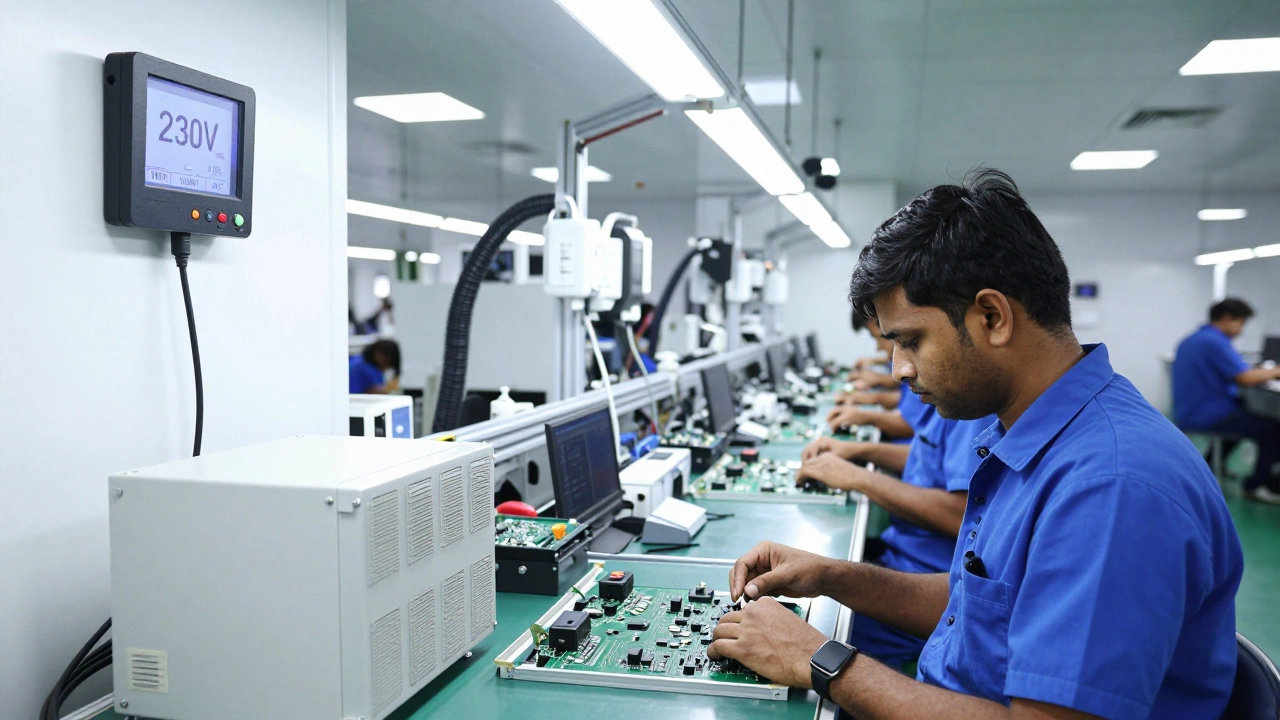
India Voltage Compatibility Calculator
India's standard voltage is 230V (tolerance: 207V-253V). This tool checks if your equipment can safely operate on India's electrical system.
When you’re setting up an electronics manufacturing line in India, one of the first things you need to get right is the power supply. A simple question like Is India 110V or 220V? can mean the difference between a smooth production start and a costly equipment failure. The answer isn’t just a number-it’s a critical design factor for every circuit board, motor, and control panel you bring into the country.
India Uses 220V, Not 110V
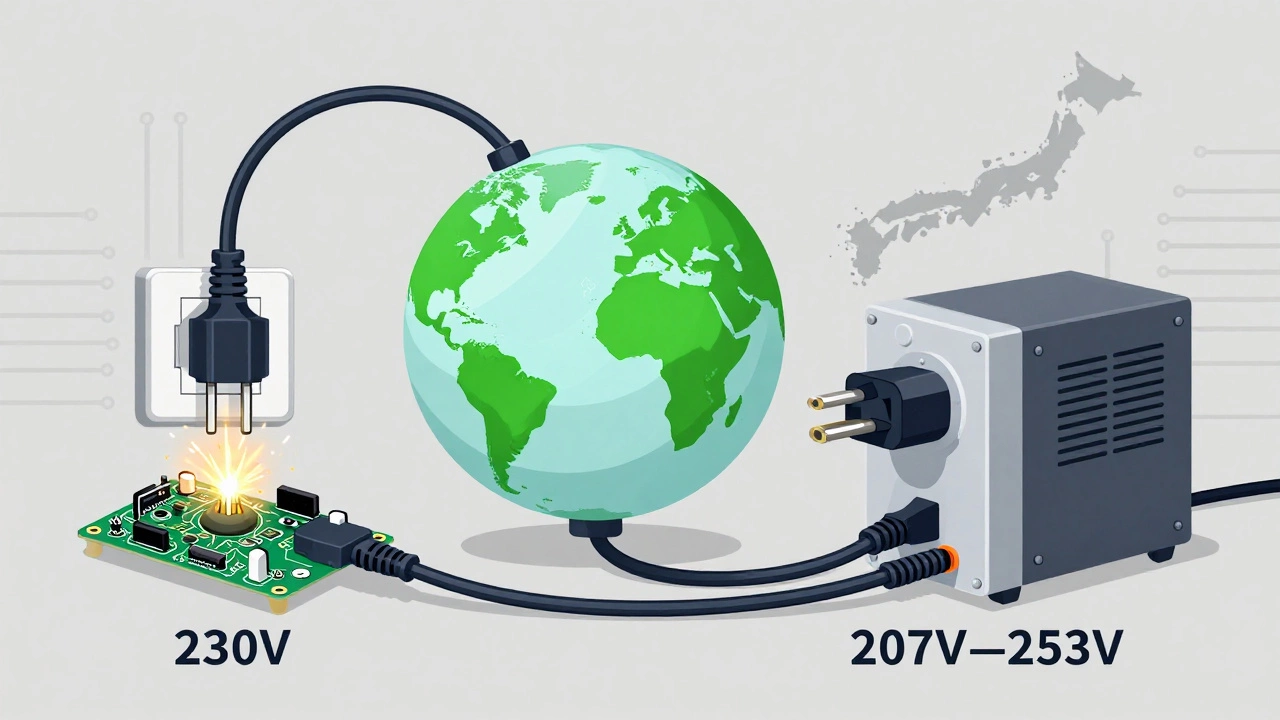
India’s standard household and industrial voltage is 230V, with a tolerance of ±10%. That means it typically runs between 207V and 253V. While you’ll still hear people say “220V,” that’s just an older term. Since 2010, India officially aligned with the international standard of 230V, following IEC 60038. This change wasn’t just paperwork-it affected everything from factory wiring to appliance labels.
If you’re importing equipment designed for 110V countries like the U.S. or Japan, you can’t just plug it in. Running 110V devices on 230V without proper conversion will fry the internal components. I’ve seen entire batches of prototype electronics ruined because a team assumed “Asia = 110V.” It’s a common mistake, but one that costs thousands in replacements.
Why India Chose 230V Over 110V
There’s a practical reason behind this. Higher voltage means lower current for the same power output. That reduces energy loss over long distances, cuts down on copper wire thickness, and lowers infrastructure costs. India’s vast rural areas and growing urban centers benefit from this efficiency. A 230V system needs about half the current of a 110V system to deliver the same power. That’s why you’ll see thinner cables in Indian homes compared to U.S. homes.
Also, most of the world-Europe, Africa, Australia, and most of Asia-uses 220-240V. India’s alignment with this standard makes it easier for manufacturers to source components, export products, and collaborate globally. If your factory is making power adapters for export, designing for 230V input means your product works in 80% of global markets without modification.
What This Means for Electronics Manufacturing
For manufacturers in India, this voltage standard shapes the entire product development cycle. Every PCB design must account for input voltage ranges. Most modern power supplies are auto-ranging-accepting 100-240V-but older or low-cost designs often aren’t. If you’re assembling consumer electronics for the Indian market, you must test for:
- Input voltage tolerance (207V-253V)
- Frequency stability (50Hz ±0.5Hz)
- Surge protection against voltage spikes
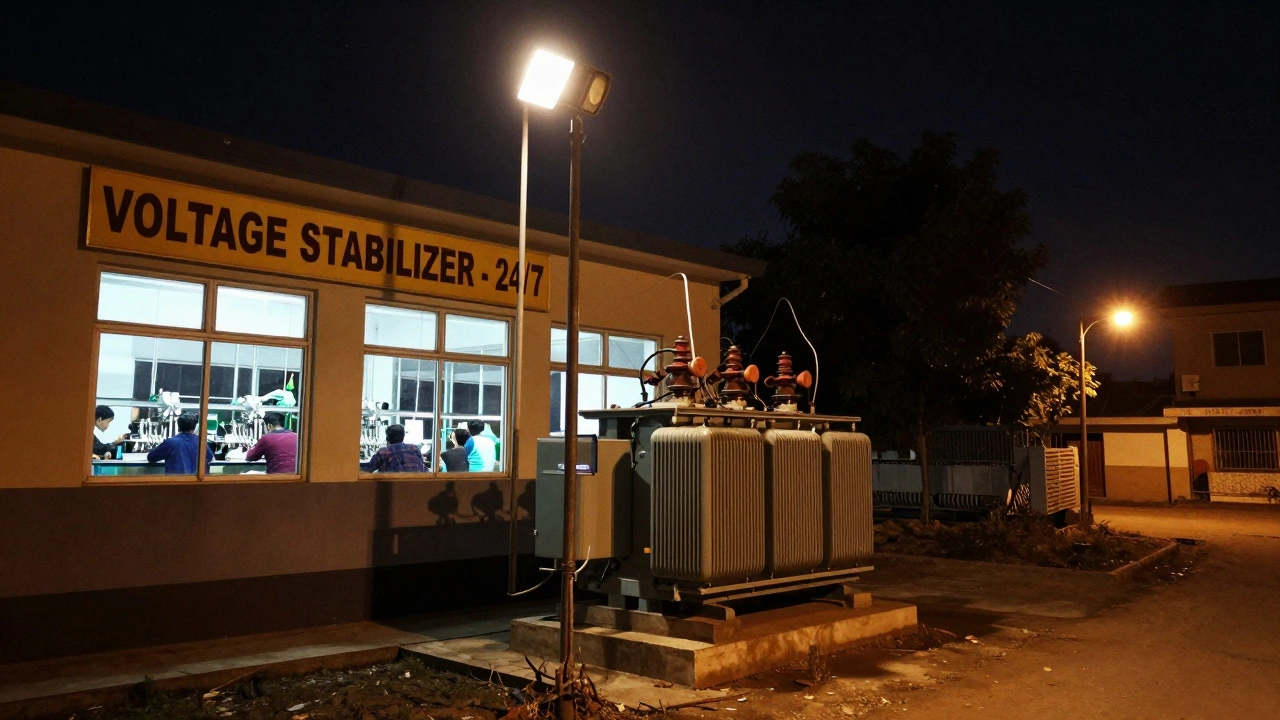
Many factories in Tamil Nadu and Karnataka now use dedicated voltage stabilizers for sensitive assembly lines. A single power surge can wipe out hours of SMT (Surface Mount Technology) work. One plant near Bangalore lost over ₹2.5 million in components during a monsoon-induced grid fluctuation in 2023. That’s why industrial sites install line conditioners and UPS systems as standard.
Common Misconceptions and Mistakes
Some manufacturers assume that because India is part of the Commonwealth, it uses the same voltage as the UK. While the UK also uses 230V, the plug types and safety standards differ. Indian plugs (Type C, D, and M) aren’t compatible with UK plugs (Type G). So even if your equipment works electrically, you still need the right plug adapter or internal rewiring.
Another myth: “If it’s labeled 220V, it’ll work fine.” Not true. Equipment labeled 220V may not handle the higher end of India’s 253V tolerance. Always check for a range-like “100-240V AC”-on the device’s rating plate. If it only says “220V,” assume it’s not safe for long-term use in India.
Even more dangerous is the assumption that “it’ll work for a while.” Voltage spikes happen daily in Indian grids, especially during monsoon season or in areas with aging infrastructure. A device might run for weeks before a surge destroys its power supply. That’s why reliability testing under real-world conditions is non-negotiable.
How to Prepare Your Equipment for India’s Voltage
If you’re bringing in machinery from abroad, here’s what you need to do:
- Check the input rating on the device’s nameplate. Look for “100-240V” or “200-240V.”
- If it only accepts 110V, install a step-down transformer rated for at least 150% of the device’s wattage. Don’t skimp on size-overloaded transformers overheat.
- Install surge protectors at the main panel and on individual machines. Look for models with clamping voltage under 400V.
- Verify frequency. India runs on 50Hz. Motors and clocks designed for 60Hz (like in the U.S.) will run 20% slower and overheat.
- Train your team. Workers need to know not to plug in imported devices without checking labels. A single mistake can shut down a line.
Real-World Example: A Factory in Pune
A small electronics manufacturer in Pune imported 200 automated pick-and-place machines from China. The machines were labeled “220V 50Hz”-seemed fine. But when they powered them on, three machines exploded within 48 hours. Investigation revealed the internal capacitors were rated for only 250V peak. India’s voltage spikes hit 270V during low-load hours. They lost $80,000 in equipment.
After that, they switched to industrial-grade power conditioners and redesigned their entire QC checklist. Now, every incoming device gets a voltage stress test before installation. It added $1,200 per machine to their setup cost-but saved them over $500,000 in avoided losses last year.
What About Rural Areas?
In villages and small towns, voltage can dip below 180V during peak hours. That’s why many manufacturers in Uttar Pradesh and Bihar use three-phase power for their production lines. Three-phase systems are more stable and deliver consistent power even when single-phase voltage drops. If you’re setting up a facility outside major cities, plan for three-phase input from the start. It’s more expensive upfront, but far more reliable.
Final Takeaway
India is not 110V. It’s 230V, with real-world swings from 207V to 253V. Treating it like a 110V country will break your equipment, delay production, and cost you money. Whether you’re assembling smartphones, LED drivers, or industrial sensors, your power design must match India’s grid reality. Don’t guess. Don’t assume. Always check the label. Always test. And always build in a safety margin.
Is it safe to use U.S. electronics in India without a transformer?
No. U.S. devices rated for 110-120V will be damaged when plugged into India’s 230V supply. Even if they seem to work briefly, the higher voltage stresses internal components like capacitors and transformers, leading to premature failure or fire risk. Always use a step-down transformer or verify the device supports 100-240V input.
Do Indian appliances use the same plugs as the UK?
No. India uses Type C (two round pins), Type D (three round pins in a triangle), and Type M (larger three-pin, similar to South Africa). The UK uses Type G, which has three rectangular pins and a fuse in the plug. Even though both countries use 230V, the physical plugs are incompatible. You’ll need adapters or rewired power cords for UK equipment.
Why does India use 50Hz instead of 60Hz?
India inherited its electrical standards from British colonial infrastructure, which used 50Hz. Most of Europe and Asia followed suit. While 60Hz systems (used in the U.S. and parts of Japan) allow slightly smaller motors, 50Hz is more efficient for long-distance transmission across large countries. India’s grid was built around 50Hz, and changing it would require replacing every transformer and generator in the country-costing hundreds of billions.
Can I use a universal power adapter for manufacturing equipment?
Universal travel adapters are fine for phones and laptops, but not for industrial equipment. They don’t handle high wattage and lack surge protection. For machines drawing more than 500W, use a dedicated voltage converter with proper grounding and overload protection. Travel adapters can melt or cause fires under heavy load.
What happens if my equipment runs on 60Hz in India’s 50Hz grid?
Motors and transformers designed for 60Hz will run 20% slower and draw more current at 50Hz. This causes overheating, reduced efficiency, and shortened lifespan. A 60Hz motor on a 50Hz supply may overheat within hours. Always confirm the frequency rating on equipment-don’t assume it’s compatible just because the voltage matches.